Red 40 and Kids: What It Is and What Regulators Actually Say
A cited middle ground between 'it's poison' and 'it's totally fine', plus what a parent can actually do in the aisle.
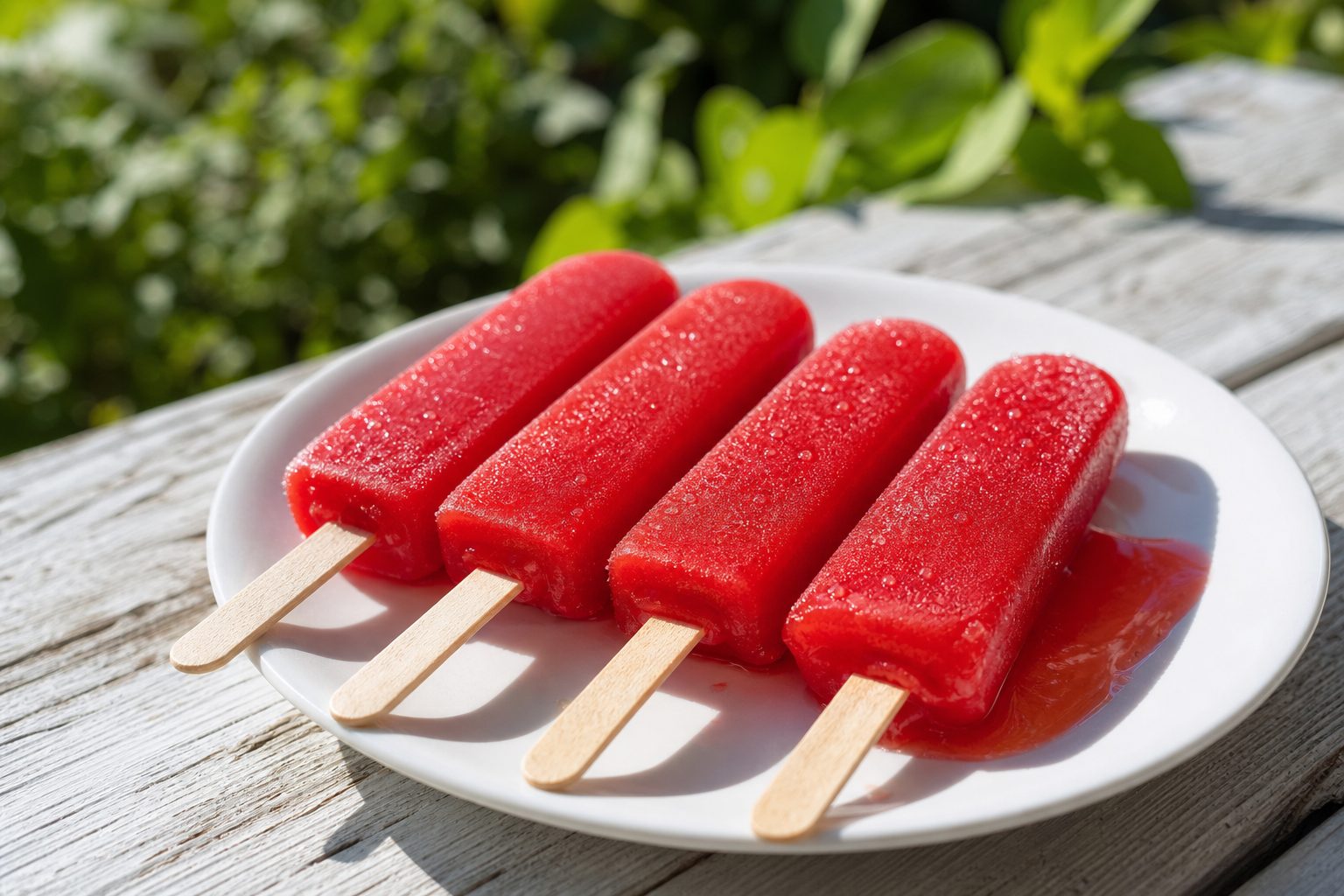
Red 40 is a synthetic, petroleum-based food dye, also listed as Allura Red AC, FD&C Red No. 40 or E129, and it is legal in both US and European food. Is it bad for kids? The honest answer sits between the headlines. Research, mainly a 2007 trial from the University of Southampton, links mixtures of synthetic dyes to more hyperactive behavior in some children, and the FDA says most children have no adverse effects while some may be sensitive. Regulators have responded differently: the EU requires a warning label, California is removing Red 40 from school food, and the FDA has asked industry to phase it out voluntarily.
This is general information, not medical advice; your pediatrician is the right person for decisions about your child's diet. For the full label routine, see how to read food labels for kids. Comparing apps? Start with seven checks before you trust a scanner's grade.
What Red 40 is, and the names it goes by
Red 40 is one of the FDA's certified color additives, and the agency's consumer guide lists cereal, beverages, gelatins, puddings, dairy products and confections among its uses. “Certified” is the FDA's term for this synthetic group; its newer documents call them petroleum-based food dyes. The confusing part is that the same dye travels under several names:
| Where you see it | How it is written |
|---|---|
| US ingredient lists | Red 40, Red No. 40 or FD&C Red No. 40 |
| Lake form of the dye | Red 40 Lake |
| Chemical or trade name | Allura Red AC, Allura Red |
| EU and UK labels | E129 or Allura red, plus a warning sentence |
Is Red 40 bad for kids? What the research says, and what it doesn't
Most of what you read about Red 40 traces back to one study. In 2007, Southampton researchers published a randomized, double-blind, placebo-controlled trial in The Lancet with 153 three-year-olds and 144 eight-to-nine-year-olds from the general population. The children drank either a placebo or one of two mixes of synthetic colors, each combined with the preservative sodium benzoate. Allura Red was in one of the mixes. The authors concluded that artificial colors or sodium benzoate, or both, increased hyperactive behavior in both age groups, though results were significant for some mixes and age groups rather than all.
What the study couldn't tell us
- It tested mixtures, so it can't say how much of the effect, if any, came from Red 40 alone.
- Every active drink also contained sodium benzoate.
- It measured behavior ratings in ordinary children, not ADHD diagnoses.
- A group average doesn't predict how any one child will respond.
How scientists and regulators read it
- EFSA (EU food safety agency), 2009: left Allura Red's acceptable daily intake unchanged and said the available data, including the Southampton study, “did not substantiate a causal link between the individual colours and possible behavioural effects.”
- California OEHHA, 2021: after reviewing seven synthetic dyes including Red 40, the state concluded they can result in hyperactivity and other neurobehavioral problems in some children, that sensitivity varies, and that federal intake levels may not sufficiently protect children's behavioral health.
- FDA: its consumer guidance reads:
“The totality of scientific evidence indicates that most children have no adverse effects when consuming foods containing color additives, but some evidence suggests that certain children may be sensitive to them.”
So “linked to hyperactivity in some children” is a fair summary. “Causes ADHD” is not, and neither is “proven harmless for every child.” If you notice a pattern in your own child, note what they ate and when, and bring it to your pediatrician.
Red 40 regulation timeline: EU, California and the FDA
| Date | Who | What happened |
|---|---|---|
| November 2007 | The Lancet | Southampton trial published |
| November 12, 2009 | EFSA (EU) | Allura Red's acceptable daily intake kept unchanged |
| July 20, 2010 | European Union | Warning label required on foods containing E129 and five other colors |
| April 16, 2021 | California OEHHA | Report links synthetic dyes to behavior effects in some children |
| September 28, 2024 | California | AB 2316 signed: six dyes, including Red 40, to be barred from K-12 school food |
| April 22, 2025 | FDA and HHS | Plan to work with industry to eliminate six dyes, including Red 40, by the end of 2026 |
| As of September 10, 2026 | FDA | Pledge tracker: still voluntary, goal now the end of 2027; Red 40 still authorized |
| December 31, 2027 | California | AB 2316 takes effect |
The EU: a warning label, not a ban
E129 is authorized in the EU. Under Article 24 and Annex V of Regulation (EC) No 1333/2008, a food containing it must add the color's name or E-number followed by:
“may have an adverse effect on activity and attention in children.”
The rule also covers sunset yellow (E110), quinoline yellow (E104), carmoisine (E122), tartrazine (E102) and Ponceau 4R (E124), often called the “Southampton six” together with Allura Red.
California: out of school food from December 31, 2027
AB 2316 covers school districts, county superintendents of schools and charter schools serving kindergarten through grade 12. From December 31, 2027, food containing Red 40, Yellow 5, Yellow 6, Blue 1, Blue 2 or Green 3 can't be served in school meals or sold on campus during the school day, with narrow exceptions such as USDA Foods. It doesn't change what grocery stores sell.

The FDA: a voluntary phase-out, not a revocation
On April 22, 2025, the FDA and HHS announced they would work with food makers to eliminate six petroleum-based dyes, including Red 40, by the end of 2026. The FDA's pledge tracker, updated September 10, 2026, now gives the goal as the end of 2027 and describes the commitments as voluntary. Red 40's authorization has not been revoked. The dye the FDA did revoke, in January 2025, is Red 3, a different color.
Shelves lag behind announcements
Products made before a company switches recipes can stay on shelves and in pantries for a while, and recipes can differ by country. Read the label on the package in your hand.
Red dye 40 foods: where it tends to show up
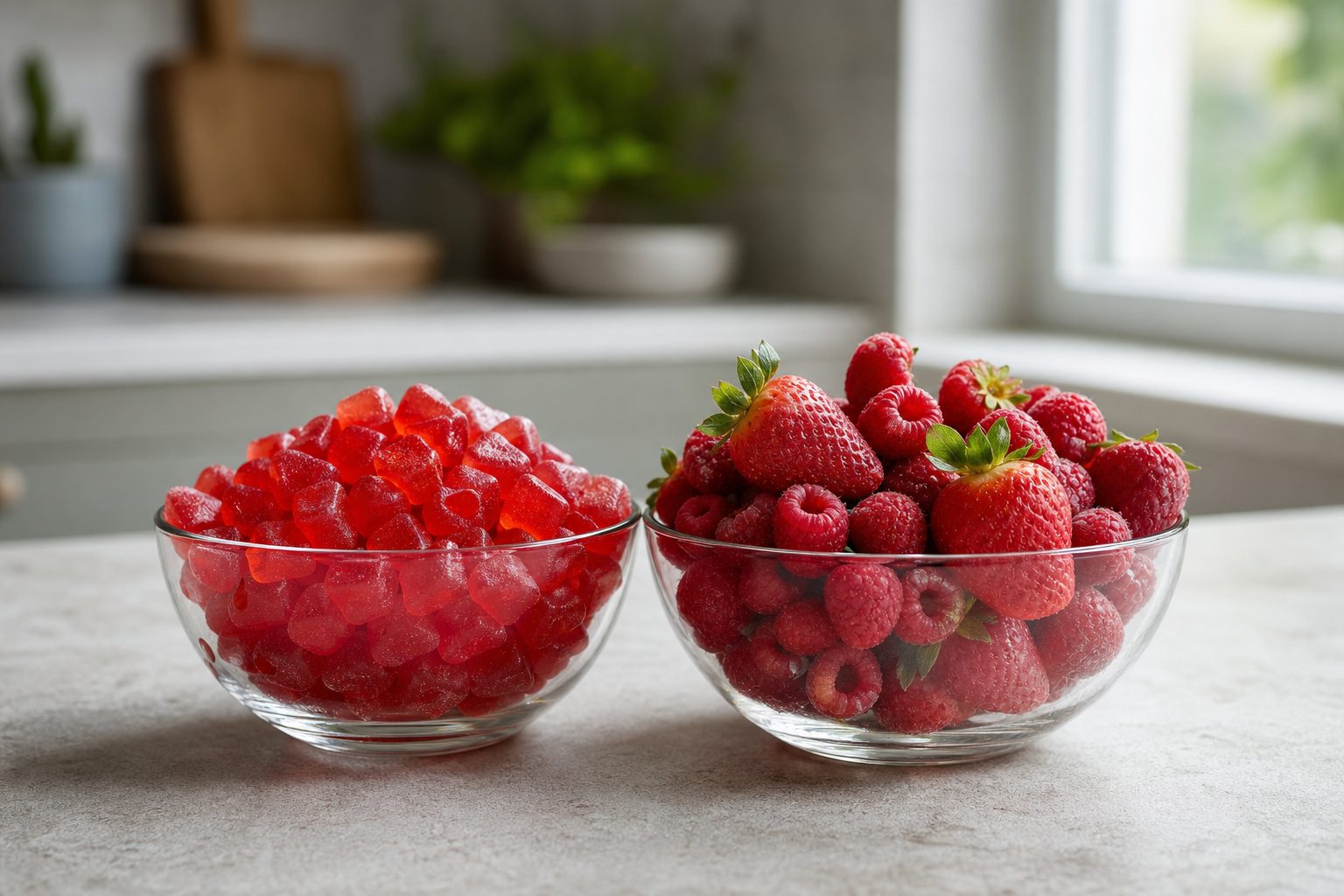
In a snack aisle, the FDA's list of uses usually translates to categories like:
- Candy, gummies and fruit snacks
- Soft drinks, sports drinks and juice drinks. OEHHA found the highest dye exposures for US children usually come from juice drinks and soft drinks.
- Brightly colored breakfast cereals
- Gelatin desserts, puddings and flavored dairy products
- Frosting, sprinkles and other confections
Not every product in those categories contains it. Many use colors from fruit and vegetable sources, and you can't tell which from the shade. Red 40 can also turn up in foods that aren't obviously red.
How to spot Red 40 on a label
- Turn the package overFront-of-pack claims are marketing. The ingredients list is where certified colors must be named.
- Look for any of its namesRed 40, Red No. 40, FD&C Red No. 40, Allura Red AC or
E129. FDA rules require certified colors to be named, so it can't hide behind a vague “color added”. - Check for the word "Lake"FDA rules require it on the lake form of a certified color, as in Red 40 Lake. It is still Red 40.
- On imported snacks, look for the EU warningProducts made for the EU or UK market print the color’s name or E-number followed by the activity-and-attention warning.
How SnackProof flags Red 40
SnackProof, launching soon on iOS and Android, does this matching for you. You photograph the ingredients panel, scan a barcode (looked up on Open Food Facts) or pick a gallery photo. The label photo goes to OpenAI only so the text can be read off it, and is then discarded. The AI reads the label. It never judges.
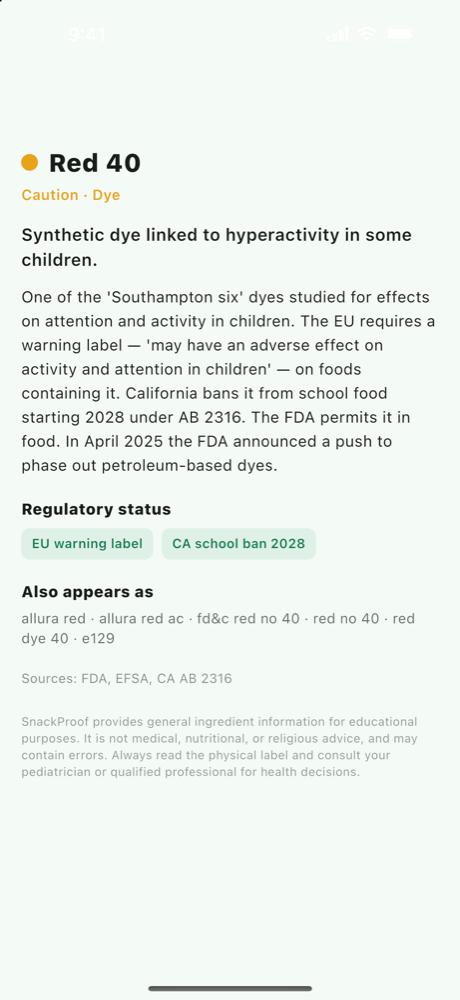
The judging happens on your phone: a fixed rules engine checks the list against a human-reviewed additive database with cited sources. Its Red 40 entry stores the dye's other names, including Allura Red AC, FD&C Red No. 40 and E129, so they all land on the same flag. Red 40 is a Caution entry marked kid-sensitive. Every scan starts at 100 points:
| Scanning for | Points off | Color |
|---|---|---|
| Toddler (0–3) or Kids (4–12) | 20 | Yellow |
| Whole family or Just me | 15 | Yellow |
So when you scan for Kids, a snack whose only flag is Red 40 scores 80, a B, but shows yellow (“Some caution flags”) rather than green, because any Caution ingredient caps the color at yellow. The same ingredient list with the same settings always gives the same verdict, and the “Scanning for” setting is free, not a Pro feature. Tap the flag to see the card below, with its regulatory chips, other names and sources. The school-rule chip reads 2028; the law's legal start date is December 31, 2027.
The limits: SnackProof reads English labels only, and its database ships with the app, so a new rule arrives with an app update, not in real time. A yellow verdict tells you what is in a snack and what regulators have said; the decision stays with you. Read more about how SnackProof separates reading from judging. At launch you get 3 free scans with no account, then Pro at $29.99 a year (3-day free trial for eligible new subscribers) or $6.99 a month; store prices may vary by region.
Frequently asked questions
Is Red 40 banned in the US?
No. The FDA still permits Red 40 in food and is pursuing a voluntary industry phase-out it now targets for the end of 2027. Separately, California bars Red 40 from K-12 school food starting December 31, 2027.
Is Red 40 banned in Europe?
No. Allura Red (E129) is authorized in the EU, but since July 2010 foods containing it must carry the warning that it may have an adverse effect on activity and attention in children.
Does Red 40 cause ADHD?
The research does not show that. Studies such as the 2007 Southampton trial link synthetic dye mixtures to more hyperactive behavior in some children, and the FDA says most children have no adverse effects while some may be sensitive. If you have concerns about your child's behavior, talk to your pediatrician.
What is the difference between Red 40 and Red 3?
They are different synthetic dyes. The FDA revoked Red 3 (erythrosine) for use in food in January 2025, with compliance required by January 15, 2027. Red 40 (Allura Red AC) is still permitted.
How can I tell if a snack contains Red 40?
Read the ingredients list for Red 40, Red No. 40, FD&C Red No. 40, Red 40 Lake, Allura Red AC or E129. US rules require certified colors to be named individually, so it will not be hidden under a generic term. Our label-reading guide covers the rest of the routine.
Sources
- FDA: Color Additives Questions and Answers for Consumers Accessed September 10, 2026.
- FDA: Tracking Food Industry Pledges to Remove Petroleum-Based Food Dyes Page updated September 10, 2026; accessed the same day.
- McCann D, et al. Food additives and hyperactive behaviour in 3-year-old and 8/9-year-old children in the community. The Lancet 2007;370:1560–1567
- EFSA: EFSA updates safety advice on six food colours (November 12, 2009) Accessed September 10, 2026.
- EUR-Lex: Regulation (EC) No 1333/2008 on food additives, Article 24 and Annex V Accessed September 10, 2026.
- California OEHHA: Report links synthetic food dyes to hyperactivity (April 16, 2021) Accessed September 10, 2026.
- California Legislature: AB 2316, Pupil nutrition: substances: prohibition (Chapter 914, 2024) Accessed September 10, 2026.
SnackProof provides general ingredient information for educational purposes. It is not medical, nutritional, or religious advice, and may contain errors. Always read the physical label and consult your pediatrician or qualified professional for health decisions.