How to Read Food Labels for Kids: Spot Dyes and Additives Fast
The hard part isn't knowing what to avoid. It's that one additive hides under three to six names. A quick order of operations for the snack aisle.

If you want to know how to read food labels for kids, the short version is this: ignore the front of the pack, turn it over, and read the ingredients list in the same order every time. Color names and numbers first, then E-numbers, then preservatives near the end, then the “Contains” line. Knowing what to look for is the easy part. The hard part is that one additive goes by several names: Red 40 might be printed as Allura Red AC, FD&C Red No. 40 or E129. Here is a routine that takes about a minute once it's a habit, plus an alias table worth screenshotting.
What to keep out of your pantry is your call, ideally made with your pediatrician. For what regulators say about one much-asked-about dye, see our Red 40 explainer. This post is about reading.
How to read food labels for kids: start on the back, not the front
Front-of-pack words are chosen to sell. For example, in February 2026 the FDA said companies may claim “no artificial colors” when a product has no petroleum-based dyes, even if it contains colors from natural sources. So the claim tells you what was left out, not whether color was added.
The back panel follows a useful rule: US ingredients are listed “in descending order of predominance by weight”. The first few ingredients are most of the pack. Additives are used in small amounts, so they tend to sit toward the end, just before the allergen line. If the print is tiny, take a photo and zoom in.
Step 1: look for color names and numbers
In the US, synthetic dyes that go through FDA batch certification must be declared by name. Manufacturers may drop the “FD&C” prefix and the word “No.”, so FD&C Red No. 40 can appear as “Red 40”, and a lake form keeps the word, as in “Blue 1 Lake” (21 CFR 101.22). The pattern to scan for is a color word followed by a number.
An artificial food dyes list to scan for
- Red 40 and Red 3
- Yellow 5 and Yellow 6
- Blue 1, Blue 2 and Green 3
- Any of these followed by “Lake”
Red 3 is a special case. The FDA revoked its authorization in food on January 15, 2025, with a compliance deadline of January 15, 2027, so products made with it may still be on shelves.
Step 2: same additive, different names
This is where label reading gets tricky. Imported snacks may use a chemical name or an E-number instead of the US name. Here are the hidden names for food dyes, plus a few other common additives.
| Additive | US label name | E-number | Other names you may see |
|---|---|---|---|
| Red 40 | FD&C Red No. 40, Red 40 | E129 | Allura Red AC, Red Dye 40 |
| Red 3 | FD&C Red No. 3, Red 3 | E127 | Erythrosine |
| Yellow 5 | FD&C Yellow No. 5, Yellow 5 | E102 | Tartrazine |
| Yellow 6 | FD&C Yellow No. 6, Yellow 6 | E110 | Sunset Yellow FCF |
| Blue 1 | FD&C Blue No. 1, Blue 1 | E133 | Brilliant Blue FCF |
| Blue 2 | FD&C Blue No. 2, Blue 2 | E132 | Indigotine, indigo carmine |
| Green 3 | FD&C Green No. 3, Green 3 | E143 | Fast Green FCF |
| Titanium dioxide | Titanium dioxide | E171 | — |
| Carmine | Carmine, cochineal extract | E120 | Carminic acid |
| Sodium benzoate | Sodium benzoate | E211 | — |
| BHA | BHA | E320 | Butylated hydroxyanisole |
Some of these names carry a warning abroad. Under EU Regulation 1333/2008, foods containing six colors, including Allura Red (E129), Tartrazine (E102) and Sunset Yellow (E110), must add this after the color's name or E-number:
“may have an adverse effect on activity and attention in children.”
That is careful regulatory wording, not a statement that a dye causes ADHD, and US rules don't require it. The Red 40 explainer covers the research behind it.
Step 3: E-numbers on food labels, and preservatives near the end
E-numbers are the EU's codes for permitted additives. The European Commission says additives should be named “by the name of their functional class, followed by their specific name or E-number”. So “Colour: E129” is Red 40 and “Preservative: E211” is sodium benzoate. On an import, the function word before the code is your cue.
Then drop to the last line or two of the list, where preservatives usually sit. US rules help here: a chemical preservative must be declared with its function, such as “(preservative)” or “to retard spoilage” (21 CFR 101.22(j)). Find the phrase and read the name just before it. Common ones include sodium benzoate (E211), potassium sorbate (E202), calcium propionate (E282), BHA (E320), BHT (E321), TBHQ (E319) and sulfites such as sodium metabisulfite (E223).
They aren't all viewed the same way. SnackProof's database, for example, puts potassium sorbate at its lowest severity and lists BHA and sodium benzoate as caution flags, each with sources. A preservative is something to notice, not an automatic no.
Step 4: read the “Contains” line, and confirm with your allergist
US law recognizes nine major food allergens: milk, egg, fish, crustacean shellfish, tree nuts, wheat, peanuts, soybeans and sesame. Each must be declared either inside the ingredient list, like “whey (milk)”, or in a “Contains” statement right after or next to it (FDA). A product can use either method, so check both. “May contain” statements are voluntary, so a missing one doesn't rule out cross-contact.
Allergies
A label guide or an app is a starting point, not a safeguard. For a child with a food allergy, confirm against the physical label and your allergist; never rely on an app alone.
The whole routine, on one card
- Turn the pack overFind the ingredients list; ignore the front.
- Scan for a color word plus a numberRed 40, Yellow 5, Blue 1 Lake.
- Check the aliasesAllura Red AC, tartrazine, E-numbers after “Colour”.
- Read the last linePreservatives, often tagged “(preservative)”.
- Read the Contains lineThen confirm allergies with the physical label and your allergist.
What a label can't tell you
- How much. Weight order is a rough hint; amounts of individual additives aren't listed.
- Which color, sometimes. Colors exempt from certification may be declared generically as “Artificial Color” or “Color Added” (21 CFR 101.22(k)). And “caramel color” on its own doesn't tell you which of the four caramel classes was used.
- How old the pack is. Products made before a deadline may still be on shelves, so a headline doesn't mean the pack in your cart has changed.
- Whether it's right for your child. That's a conversation for your pediatrician.
Letting an app do the alias matching
The routine works, but it's slow while you're holding a toddler and a shopping cart. SnackProof, launching soon on iOS and Android, follows the same steps.
- Same starting point. The camera says “Fill the frame with the INGREDIENTS panel”. You can also scan a barcode (looked up on Open Food Facts) or pick a photo from your gallery.
- The AI only reads. The photo goes to OpenAI to transcribe the ingredient list and allergen statement, then is discarded. It never judges.
- Rules match the aliases. Each ingredient is checked against a human-reviewed database of 168 additives and their aliases. E-numbers must match exactly (E150a and E150d are different caramel classes), while longer names tolerate OCR typos like “sodum benzoate”.
- The grade is computed on your phone. A to F, green, yellow or red, and the same ingredient list with the same settings always gives the same verdict. Scanning for a Toddler or Kids weights kid-sensitive additives like Red 40 a little more. That setting and dietary flags are free.
- Every flag shows its work: a plain-English explanation, regulatory chips, “Also appears as” names and sources.
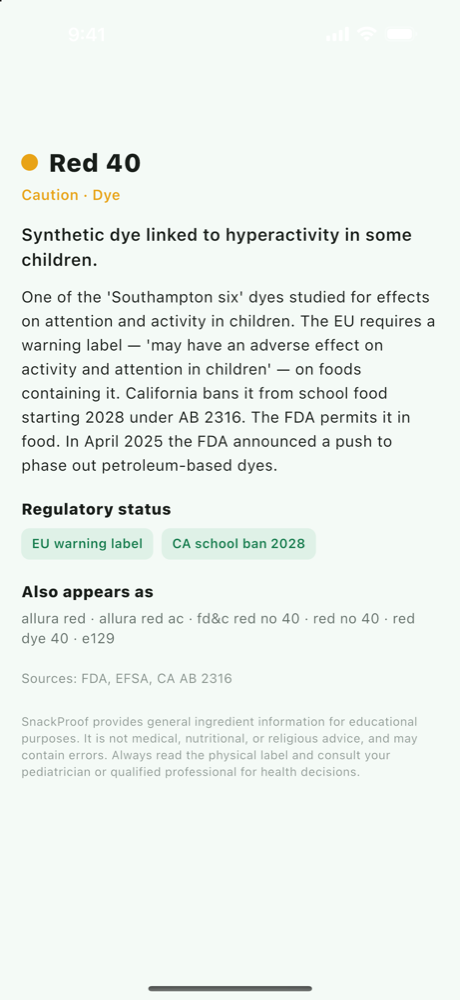
For allergens, the verdict shows the label's own statement under “Allergen statement (from the label)”; it doesn't detect allergens. Other limits: English labels only, a connection is needed to read a new label, and database updates arrive with app updates.
You get 3 free scans with no account. After that, Pro is $29.99 a year (3-day free trial for eligible new subscribers, annual plan only) or $6.99 a month; store prices may vary by region. See pricing and how SnackProof separates reading from judging. Comparing apps? These seven checks before you trust a food scanner app's grade work for any of them.
Frequently asked questions
What are the hidden names for food dyes on an ingredient label?
The most common are Allura Red AC or E129 (Red 40), tartrazine or E102 (Yellow 5), Sunset Yellow FCF or E110 (Yellow 6) and Brilliant Blue FCF or E133 (Blue 1). US labels may also shorten FD&C Red No. 40 to Red 40, and a lake form must include the word Lake.
Do US food labels use E-numbers?
US labels list ingredients by their common or usual name, such as Red 40. E-numbers are the EU's codes for permitted additives, so you mostly see them on products made for the EU or UK market.
Does 'artificial color' on a label mean Red 40?
Not necessarily. US rules require certified dyes such as Red 40 to be named individually. Generic terms like Artificial Color or Color Added are allowed for colors exempt from certification, so they don't say which color was used.
Does 'no artificial colors' on the front mean no color was added?
No. In February 2026 the FDA said companies may use that claim when a product has no petroleum-based dyes, even if it contains colors from natural sources. Check the ingredients list.
Are artificial food dyes being banned in the US?
Not across the board. The FDA revoked Red 3's authorization in food in January 2025, with compliance required by January 15, 2027. For six other certified dyes, including Red 40, the FDA has set a goal of eliminating them by the end of 2027 and is tracking industry pledges to remove them. Our Red 40 explainer has the full timeline.
Sources
- eCFR: 21 CFR 101.4, Food; designation of ingredients Accessed September 10, 2026.
- eCFR: 21 CFR 101.22, labeling of flavorings, colorings and chemical preservatives Accessed September 10, 2026.
- FDA: Have Food Allergies? Read the Label Accessed September 10, 2026.
- FDA: FDA Takes New Approach to “No Artificial Colors” Claims (February 5, 2026) Accessed September 10, 2026.
- FDA: Tracking Food Industry Pledges to Remove Petroleum-Based Food Dyes Page updated September 10, 2026; accessed the same day.
- EUR-Lex: Regulation (EC) No 1333/2008 on food additives, Article 24 and Annex V Accessed September 10, 2026.
- European Commission: Food additives Accessed September 10, 2026.
SnackProof provides general ingredient information for educational purposes. It is not medical, nutritional, or religious advice, and may contain errors. Always read the physical label and consult your pediatrician or qualified professional for health decisions.